Wednesday, October 31, 2018

Canada Topped the List of World’s Most Positive Countries for the First Time Ever


·         Canada made it to the top for the first time ever in the 8th year of this award series.

·         The USA could not make it to the main list of positive countries for the first time.

·         Japan made it back to the list of positive countries since 2014. Singapore and New Zealand made it back since 2016.

·         Ethiopia, North and South Korea, Iceland, the USA and Chile are the regional winners.

·         Winning it for the World as a Team, was the main theme observed among all the positive news from 2018.

·         For the first time in last five years, global citizens had positive projection for the world.


Canada was named as the World’s Most Positive Country in 2018 for the first time ever, according to the annual global index published by Daily Positive (D+), a unique online media organization from Australia for positive news. 

The annual list of top ten most positive countries is compiled based on a positivity index comprised of a global expert panel rating, a D+ journalists rating, a global web poll and the number of positive news entries in 2018 on the D+ website.

The top 10 World’s Most Positive Countries for 2018 along with respective ranking points are as follows:


Figure: Top 10 World’s Most Positive Countries for 2018

Apart from this overall list of 10 most positive countries, D+ also published a list of regional positive countries from Africa, Asia, Europe, North America and South America. The regional winners were selected based on the same criteria used to select the overall winners but from a specific region outside of the top ten in the list. 


Canada was crowned as the World’s Most Positive Country in 2018 for the first time ever in the 8th year of this award series. Canada has been persistent throughout this journey with advanced scientific research, economic development and for standing up for the values that they believe in. Canadian researchers have developed a handheld 3D skin printer that deposits even layers of skin tissue to cover and heal deep wounds. Canadian scientists have developed T-CUP, the world’s fastest camera, capable of capturing ten trillion frames per second. The Nobel Prize in Physics 2018 was jointly awarded to Donna Strickland of Canada. Dr. Strickland is the third woman to receive the Nobel Prize in Physics since its creation in 1895, and the first female laureate in 55 years in this discipline. Despite being put under unprecedented pressure by other countries, such as the USA and Saudi Arabia, Canada showed strong courage and came out as the winner at the end. They were able to secure new North American Free Trade Agreement (NAFTA) deal and were able to keep the unemployment rate down, at one point the unemployment rate dropped to 4-decade low at 5.8%. Finally, Canada has created the largest area of protected boreal forest in the world in Alberta, an area twice the size of Belgium.

Australia lost its crown from last year to Canada and is in the second position. In 2018, political instability slowed the amazing run that the Australian had for some time. Despite the slow run, Australia was steady. Australian researchers have developed the world’s first blood test capable of detecting melanoma in its early stages, a breakthrough that will save thousands of lives, as well as millions of dollars for the health system. Professor Akshay Venkatesh became the second Australian to be awarded the most prestigious prize in the mathematics world, the Fields Medal. Australia's first electric plane, the Pipistrel Alpha Electro two-seater, successfully completed its maiden flight. Also, Australia gained global admiration by hosting an impressive Commonwealth Games in the beautiful Gold Coast.

Japan had the most impressive climb of all time in the list of most positive countries. The last time Japan was in the list of most positive countries was in 2014. In four years, they turned it around and jumped into the third position in 2018. According to UNICEF, Japan ranked as the world’s safest country for the newborn with lowest newborn mortality rates. Japanese film director Hirokazu Kore-eda’s Shoplifters won Palme d’Or at the Cannes Film Festival. Japan signed a Free Trade Agreement (FTA) with the European Union (EU) that covers 600 million people and almost a third of the global economy. Naomi Osaka of Japan defeated Serena Williams to win the 2018 US Open women’s singles tennis title, becoming the first Japanese player to win a major singles title in the history of the sport. Most recently, Japanese passport was ranked as the most powerful in the world.

England climbed up four spots in the list of most positive countries from last year and is in the fourth position. Researchers from the University of Oxford in England have completed the first successful trial of robot-assisted eye surgery. English scientists have discovered three new species of fish, temporarily named the pink, the blue and the purple Atacama Snailfish, in the extreme depths of the Pacific Ocean. English scientists have succeeded for the first time in wiping out an entire population of malaria-carrying mosquitos in the lab. English teacher Andria Zafirakou, from the Alperton Community College of Brent in one of the UK's poorest areas, won the $1 million Global Teacher Prize.

China is in the fifth position in the list of most positive countries for 2018. On our global poll, China was seen as the most focused country with clear aims. China continued to march forward with their BeiDou navigation and positioning system and successfully launched the planned satellites for 2018 required for the system. In a world first, Chinese researchers have successfully cloned macaques using the same technique that yielded the famous clone Dolly the sheep. Chinese researchers have created new ultrafine films—based on nanoparticles that are more than 80 times thinner than a human hair—that could lead to materials that can holographically archive more than 1000 times the data as a DVD. China officially opened the world's longest sea crossing bridge, spanning around 55km and connecting Hong Kong to Macau and the mainland Chinese city of Zhuhai, yet another sign of rapid development that China is focusing on both inside and outside of the country.

France moved down one spot to the sixth position in the list of most positive countries compared to last year. Among all the positive achievements of France, the 2018 FIFA world cup win was the most memorable and admirable for the French people. It was France’s second world cup title. Apart from that, in a world first, doctors at the Georges-Pompidou European Hospital in France have performed second face transplant on the same patient. France has been in the forefront of the global environmental campaign. As a result, French President Emmanuel Macron was awarded the 2018 United Nations (UN) Champions of the Earth Award in the Policy Leadership category for his pioneering work on the Global Pact for the Environment.

Singapore came back strong with some upbeat accomplishments to take the seventh spot in the list of most positive countries for 2018 after missing out last year. Scientist in Singapore have become the first in the world to 3D print human skin that match our natural colors and pigmentation. Singapore airlines and the Changi Airport continued to be the very best in the world. Singapore was ranked as the safest country in the world for third consecutive year according to the annual Gallup Global Law and Order report. Singapore topped the World Bank Group's Human Capital Index that quantifies the contribution of health and education to the productivity of the next generation of workers.

Germany made it to the eighth position in the list, two spots down from last year. Some of the notable German initiatives from 2018 are, Germany was elected as a non-permanent member to the United Nations (UN) Security Council to serve during 2019-2020. Germany rolled out the world's first hydrogen-powered train, the Coradia iLint, in northern Germany powered entirely by eco-friendly hydrogen fuel cells. Despite notable opposition against the Refugees in Germany, our global poll participants hailed Germany as the Humanitarian Champion for its leadership in supporting the Refugees. Apart from that Germany remained innovative with global scientific collaborations, such as, a German-English team have found a way to harness sunlight to make fuel by splitting water into hydrogen and oxygen.

Denmark clinched a spot in the list of most positive countries for the second consecutive year and is in the ninth position. Denmark topped the ranking at the 2018 United Nations (UN) E-Government Survey, which measures countries’ use of information and communications technologies to deliver public services. Denmark has been supportive to the environmental issues. For instance, wind power generated over 40 percent of electricity consumed in Denmark, a record for the Nordic nation which aims to rely on renewables for half of its energy needs by 2030. Speaking of the year 2030, Denmark has announced plans to phase out diesel and petrol cars, banning the sale of these vehicles from 2030 onwards.

New Zealand took the last spot in the list of 10 most positive countries for 2018. According to one of our external-panel members, “New Zealand seems to keep it to themselves and keeps a low profile, while still making strong statements in various social issues”.  New Zealand did justice to that comment as they ranked as the least corrupt country in the world. New Zealand's parliament passed a law granting paid leave for victims of domestic violence. Apart from that New Zealand scientists have performed the first-ever 3-D, color X-ray on a human, using a technique that promises to improve the field of medical diagnostics.


D+ Most Positive Regional Countries 2018


Africa: Ethiopia
Ethiopia, for the first time ever, made it to the list of most positive regional countries. Ethiopia stood out with their dedication to establish peace and good relationship with their neighbors. Ethiopia signed an agreement with Eritrea to officially end the war between the countries that first broke out in 1998. A 756-km electrified railway connecting landlocked Ethiopia to Djibouti officially started commercial operations. Ethiopian airline made the first commercial flight between Addis Ababa and Mogadishu in Somalia in 41 years, in yet another sign of warming ties between the neighboring nations. Apart from that Ethiopia was in the news for some popular internal policies, such as, Ethiopia's parliament elected Sahle-Work Zewde as the country's first female president and Ethiopian Prime Minister Abiy Ahmed appointed a cabinet with half the posts taken up by women.

Asia: North and South Korea
North and South Korea were jointly named as the most positive countries from Asia in recognition of the ongoing peace process between the two neighboring countries. North and South Korea committed themselves to the complete denuclearization of the Korean Peninsula and pledged to bring a formal end to the Korean War. This by far was the most popular and talked-about positive news in 2018 according to the global news coverage and social media attention. Additionally, both the countries shined in sport events, such as, Winter Olympics and Asian Games in 2018.

Europe: Iceland
Iceland took the regional title of Europe. Iceland became the first country in the world to legalize equal pay between men and women in bid to close gender gap. Under the new rule, companies and government agencies with more than 25 employees will face fines if they cannot demonstrate that men and women receive the same salary for the same job. Iceland was ranked as the most peaceful country in the world according to the 2018 Global Peace Index. Icelandic economy was ranked as the second best among the advanced economies by the World Economic Forum.

North America: The United States of America (USA)
The United States of America (USA), for the first time ever, could not make it to the main list of positive countries. This year the USA did not have enough support on our global poll and from our expert panel members. However, the USA was crowned as the regional winner from North America. As expected, the USA retained its leading position in scientific innovation. For example, American biologists have successfully transferred a memory from one marine snail to another, creating an artificial memory. This research could lead to new ways to restore lost memories. The USA also dominated the list of Nobel Prize winners as their researchers won the prize in Medicine, Physics, Chemistry and Economic Science in 2018.

South America: Chile
Chile is back as the regional winner from South America since 2015. Chile made history when it became the first country in Latin America to ban the commercial use of plastic bags. Chile created a new law protecting the waters along its 6,400km (4,000 mile) coastline which creates nine marine reserves. Other notable positive achievements are, Chilean film A Fantastic Woman won the Best Foreign Language Film award at the 90th Academy Awards and Chile was recognized as the Leading Adventure Tourism Destination in Latin America at the 2018 World Travel Awards.

This year 4117 global citizens participated in our global poll with 47% men and 53% women. This is the third consecutive year we had more women participants than men. The global poll was successful in attracting approximately uniform amount of votes from all the regions of the world. The age distribution of the participants suggests, people aged between 30 to 50 were the most vocal in our poll.

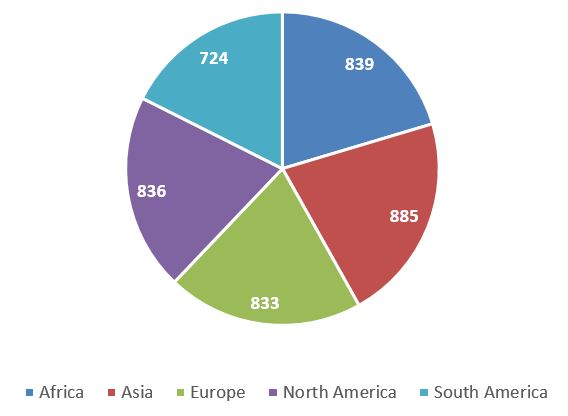


Figure: Global poll participants in graphs


Based on our text analysis of all the positive news published on D+ in 2018, it is observed the World aspired to work as a Team and Won. That was the main theme observed among all the positive news, as Won, World and Team were the three most used words among all the positive stories from 2018. We also looked at the associated words to these three most used words. The association analysis revealed that when the world worked as a team women turned out to be the winner, economy grew and science had international impact.


Figure: Analysis of all the positive news from 2018

The most popular topics of positive accomplishments among both men and women on our global poll, in sequence, were Humanitarian Initiatives, Environment, World Peace, Science & Innovation, Economy, International Relations and Anti-Corruption Initiatives. Women had higher number of votes on each of the mentioned topics, except International Relation. Two new entries to this list of topics in 2018 were Humanitarian Initiatives and Anti-Corruption Initiatives. Further analysis of the comments made on the global poll suggests, the participants reacted positively to the overall Humanitarian Initiatives around the recent refugee crises, wars and natural disasters. Also, a strong voice against corruption was shouted which was often blamed for the most of the political crises in a country.


Figure: Popular topics of positive accomplishments among men and women

For the first time in five years it was observed that the percentage of people hopeful for positive future of the world, primarily the immediate future, climbed in the upward direction. This positive projection was not necessarily because all of our global poll participants believed something magical is taking place around the world but because people believed it is about time for the worse to be over.


Figure: Percentage of people hopeful for positive future

There were so many other positive stories that took place beyond the above winners’ list. India made unprecedented pledge to eliminate all single-use plastic in India by 2022. Various new laws empowering women in Morocco, including a new law criminalizing violence against women, came into effect. Malaysia's cabinet has agreed to abolish the death penalty and halt pending executions.

“In 2018 there were so many positive stories all around us, from Bangladesh's continuous support for world's most prosecuted minority – the Rohingya People of Burma, to denuclearization of Korean peninsula, to Africa standing up for itself with Continental Free Trade Area agreement and many others. These positive stories are not only inspiring but also major steps towards the right direction.” says Dr. Arif Jubaer, Founder of D+.

D+ will present the above information and facts in detail at a presentation ceremony on Saturday, 24 November 2018, 2.00PM in Melbourne, Australia.

For more information on the World’s Most Positive Countries 2018 visit http://www.dailypositive.org/Most_Positive_Countries


Thursday, May 10, 2018

What Is Burma's Next Move In Relation To The Rohingyas?


Before I talk about Burma’s next move, let me share two interesting facts:
  1. Human brains are wired with use-it-or-lose-it quality. We remember or remain concern about a fact as long as it is used, read, exposed or presented to us.

  2. Typically newspapers push the front-page headline to the back-pages in span of 10-14 days, according to our own research at D+. It doesn't matter how big or significant the event is, after about 2 weeks, it is almost certain that the news is no longer on the front page or probably vanished all together.
Combine the above two facts and you get a perfect recipe for people who hope their past irresponsible and unlawful actions will be forgotten by the wider communities.

And Burma is currently hoping for that combination dearly for their past actions against the Rohingyas.


One of many Rohingya camps in Bangladesh


Burma is trying to achieve that by maintaining “Military Silence”.  Military Silence is a technique to control your reactions to issues and events that involves you for the purpose of getting your way. In the war zone military will often use this technique to give the false impression of silence and then to ambush. 

This works because others’ reactions to your actions will let you decide your best next move. By maintaining military silence, you gain clarity in your planning and precision in execution. That leaves you with the control to win the battle.

As part of that, the Noble Peace Prize winner Aung San Suu Kyi remained silent while supporting the Burmese Army in their atrocities against the Rohingyas. 

As next step, Burma cannot effort any new widespread violence. Thus, as our sources on the ground confirmed, the Burmese security forces have increased patrolling of the volatile areas and chosen intimidation as a technique to keep the Rohingyas away. We also have acquired information which suggests Burmese Army continued to lay land mines across the border with Bangladesh. 

The other option available to Burma is diplomatic efforts to convince the international communities to believe their side of the story. Though it sounds like hard-sell, Burma already managed limited supports from some influential Asian economies. These large economies intend to provide supports purely for business purposes, completely ignoring the humane factors involving the Rohingyas. 

As part of Burma’s recent diplomatic effort, top level Burmese diplomates are pressing hard on their accelerators with various western countries around the world. So far it seems like they were not overly successful but they do not mind that. Because they do not expect all these western countries to be in their side, instead they want the western countries and others concern about the Rohingyas to go silent. 

Most importantly Burma is now in a very good position to use this mess as a bargaining chip. They are already, directly or indirectly, shouting out for financial incentives from everyone in return for taking back limited number of Rohingyas.

Burma will continue its diplomatic efforts hoping this issue will fade away and will have a natural death soon. Burma will try some tricks like they did by taking one Rohingya family back, out of a million Rohingyas who fled the violence, from their own border area and publicizing that heavily. Despite our best efforts we could not find any trace of that Rohingya family in Burma. 

Thus, it is up to us – you, me and others – either to go silent and forget about the Rohingyas or to keep up the pressure on Burma. As announced before, through our non-violent initiative named World's Largest Hunger Strike we intend keep up the pressure.  Join us in the World's largest Hunger Strike to create awareness against the ethnic cleansing of Rohingya people of Burma. For details on how to participate in the hunger strike visit us at http://jubaerarif.blogspot.com.au/2018/04/lets-make-it-worlds-largest-hunger.html #Rohingya

Tuesday, April 03, 2018

Let’s Make It The World's Largest Hunger Strike

Recently I have visited the Rohingya camp in Bangladesh and stories that I heard are heart-wrenching.

Burmese Army under the leadership of Nobel Peace Prize Winner Aung San Suu Kyi killed over 10,000 Rohingyas including days old children, committed many more thousands rape of Rohingya women and forced about 1 million Rohingyas out of their lands in Burma. It is time to stand against this atrocity.

During my visit to the Rohingya camp in Bangladesh 

Join us in the World's largest Hunger Strike to create awareness against the ethnic cleansing of Rohingya people of Burma. Followings are the general guideline:

  • Fast for 4 continuous hours.
  • You can do it any day of the year and any time of the day. 
  • You can do it yourself or with family, friends and neighbours.
  • You do not need to allocate a separate time for the fasting. It can be done while you are at work, at home or traveling.
  • You may take a picture of you and others while fasting and share that on your social media with hashtag #StopBurningMyChild
  • We have started fasting from March 2018 as part of the D+ carnival and will continue for the rest of the 2018 or beyond.
  • Do it only if you are physically capable.
  • You can fast for once or multiple times or as many times as possible. Every bit helps.
  • Of course let us know, if you are fasting.


Let's stand with the Most Persecuted Minority in the World, the Rohingya people of Burma, with this non-violent movement.

For more update on Facebook visit D+ campaign page at https://www.facebook.com/StopBurningMyChild/

Thursday, March 22, 2018

Pain of Badsha Mia

Most recently I met a large number of people with no concept of year, month, week, date and time. I know what you are thinking. Your mind raced to some of Brazil's Amazonian tribes.

Unfortunately, you are wrong! I was not talking about any isolated Amazonian tribe. I was referring to the Rohingya people of Burma. The Rohingyas were oppressed for so long to the level that they were forced to live without any access to basic knowledge and contact with the outside world. The Rohingyas did not have access to proper educations, medical facilities, water system and not to mention did not have any real jobs.

Badsha Mia, one of the Rohingya man who fled the ongoing genocide in Burma, is one of such "isolated Amazonian tribe member". The only concept of time that he has, Day and Night based on his experience in Burma. According to him, during the day time you go out and find food. After the sun sets, you do not go out because as Rohingya if you were out of your home you were more likely to be killed in your neighborhood.

Along with the year, month, week, date and time, Rohingyas are not aware of or do not have access to family planning measures. As a result, it did not come as surprise to me when I discovered Badsha Mia had 14 members in his family.


Two of the younger members of Badsha Mia's family of 14


Now imagine yourself as Badsha Mia for 12 days, fleeing a well armed Burmese military trying to kill your entire family and you had to hide, walk, crawl and at times run along with all the 14 family members to the safety in Bangladesh. During the journey there were no food, so you ate grass. Babies were crying, so you had to insert your fingers in their mouth so that the noises do not reach the Burmese army. Female members of your family were going through menstrual cycle, so you had to use plant leaves as protection.

This reminds of a scene that you see in African animal safari, where Hyenas chasing a beautiful mother Gazelle to tear it apart and the fear that it generates in the baby Gazelles' eyes and minds.

After his stressful and fearful journey, Badsha Mia made it to Bangladesh from Burma, after 12 days, with all of his family members barely alive. But many were not as lucky as him. They were either killed by the Burmese Army or died during this dangerous journey not only from the above mentioned causes but also because of the mines that the Burmese Army placed along the border with Bangladesh.

It hurts Badsha Mia and other Rohingyas the same way as it hurts you to lose a family member to hate, pure hate. Rohingyas like Badsha Mia who fled to Bangladesh are safe for now but carrying deep mental pain that is beyond measure. They are alive but they die every single second of the day in their tiny little huts in Bangladesh.

Let's create continuous awareness and pressure on Burmese leader Aung San Suu Kyi and her team to stop the genocide against the helpless Rohingyas and to ensure the safe return of the Rohingyas to their own home.

Thursday, February 22, 2018

Story of Hosni Ara

Hosni Ara, a Rohingya Muslim woman from Burma, was running as fast as she could with her 5 children as the Burmese Army attacked her village in the Rakhine state of Burma in 2017. She was carrying two of her little children on her shoulders and was guiding the elder ones as much as she could. As you could imagine, she was falling behind in the process compared to the other villagers and that turned out to be fatal.

Image: Collected

She was captured by the Burmese Army along with her 5 children. The first thing that the Army did, created a huge fire. They snatched the two babies from Hosni Ara's lap and threw them in the fire. Stripped Hosni Ara naked and made her watch two of her babies screaming and burning to death, while one after the other Army officers were raping her. The eldest three children were forced to see their mother being raped.

She still hears the scream of her babies so much that she hardly cares about her rape. Even today when she tells you the story, her voice echoes the pain she felt and that pain in her voice is only comparable to multiple of labor pains.

This is not a rape scene from a B-grade movie rather it is a reality for many of the Rohingya women captured by the Burmese Army. I heard so many stories like these during my visit to Rohingya refugee camp in Bangladesh in February 2018. In the coming days, I want to share more of my experiences with the world. The world cannot turn a blind eye to what is happening to the Rohingyas.

Wednesday, November 01, 2017

Australia Reclaimed the World’s Most Positive Country Title in Half a Decade


  • Australia returned to the top spot for the first time since 2011.
  • There are four changes in the overall list of positive countries in 2017 compared to last year.  Denmark and the Netherlands made it to the list for the first time ever. 
  • France and England are back to the list of positive countries since 2014 and 2015 respectively.  Nigeria, Bangladesh, Norway, Cuba and Colombia are the regional winners.
  • Analysis of all the positive news from 2017 suggests that the newsmakers worked with passion to create a positive impact in the world.
  • Global citizens continued to be less hopeful for the immediate positive future of the world.


Australia crowned the World’s Most Positive Country for 2017, for the second time ever in half a decade, according to the annual global index published by Daily Positive (D+), a unique online media organization from Australia for positive news. 

The annual list of top ten most positive countries is compiled based on a positivity index comprised of a global expert panel rating, a D+ journalists rating, a global web poll and the number of positive news entries in 2017 on the D+ website.

The top 10 World’s Most Positive Countries for 2017 along with respective ranking points are as follows:

Country Name
Total Points
Australia
501
Canada
489
Switzerland
480
China
472
France
461
Germany
454
Denmark
442
England
434
Netherlands
428
United States of America
418


Apart from this overall list of 10 most positive countries, for the third time, D+ also published a list of regional positive countries from Africa, Asia, Europe, North America and South America. The regional winners were selected based on the same criteria used to select the overall winners but from a specific region outside of the top ten in the list.

Australia topped the list of most positive countries in 2017 and it took them half-a-decade to reclaim the top spot. Gradual development and patient build up over the past few years helped Australia return to the top. Australian medical research continued to explore new ideas with worldwide impact. Other research areas have also been impressive, for example, Australian archaeologists have confirmed that Aboriginal people have been in Australia for at least 65,000 years – much longer than the 47,000 years thought previously. First Australian-built satellite CubeSat was launched in 15 years. Women’s sports was flying high, including Australian women’s football team winning the inaugural Tournament of Nations defeating Brazil. Our global survey suggests Australia was seen as a positive role model especially against the changing political situation in North America.

Canada jumped into the second spot in 2017 from last year’s fifth position. Canadian universities were impressive with their researches. Canadian researchers at the University of Waterloo have captured the first composite image of a dark matter bridge that connects galaxies together. Canadian scientists from the Royal Ontario Museum have identified and named a new species of armoured dinosaur, Zuul crurivastator. Like Australia, Canada has also emerged as new positive voice against global political instability. In line with that positive vibe, Canadian school teacher Maggie MacDonnell won the annual Global Teacher Prize for encouraging hope and acts of kindness in a remote Arctic village called Salluit in Quebec.

After two years at the top of the list of most positive countries, Switzerland moved down to third in the ranking in 2017. “While maintaining stability, prosperity and livability internally, and hosting a range of international organizations, Switzerland continued to be exemplary”, says one of our expert panel members. Swiss tennis master Roger Federer’s incredible reemergence with Australian Open and Wimbledon Grand Slams was one of the most inspirational sporting stories of 2017. The Charles Kuonen Suspension Bridge, the world's longest suspension footbridge - measuring over 1600 feet in length and rising as high as 279 feet, was opened in the country as part of continuous development. Swiss scientists have succeeded in deciphering the entire visual network in the brain of a fly that is expected to support brain research. Finally, Switzerland retained its rank as the world’s most competitive economy for the ninth consecutive year.

Like Switzerland, China also shifted down two positions in the list of positive countries in 2017. Despite the shift, China through the Belt and Road initiative, has been stimulating a range of infrastructure development projects throughout the world and strongly emerged as leader in world affairs. China not only changed the stigma of world’s worst polluter but also established itself as the renewable energy champion. China topped the world in renewable energy production, connected the world’s largest floating solar PV power plant to the grid and topped the Renewable Energy Country Attractiveness Index in 2017. Among other positive initiatives, Chinese researchers teleported the first ever object, a photon, from the earth to a satellite orbiting more than 500 kilometers above.

France made it back to the list of most positive countries after two years and secured the fifth spot in 2017. France was highly praised in our global poll for its resilient and courageous stand amid all the recent terrorist attacks on French soil and to let that attitude to shine by electing a fresh government. Apart from that, France banned the breeding of killer whales and dolphins in captivity, French model Iris Mittenaere was crowned as the 65th Miss Universe and because of the revolutionary research work by French scientists a man in a permanent vegetative state (PVS) for the past 15 years has shown signs of consciousness after pioneering nerve stimulation treatment.

Germany moved up two positions in the list in 2017 compared to last year.  German economy remained solid and as a result, the unemployment rate has been downhill in 2017.  German scientists continued to innovate and impress. The world's biggest solar simulator Synlight was switched on in Germany, dubbed as "the world's largest artificial sun", intended to develop production processes for solar fuels, including hydrogen. German scientists have recently, for the first time, extracted full nuclear genome data from ancient Egyptian mummies.

Denmark made it to the list of most positive countries for the first time ever and reached at the seventh position. In 2017, Denmark ranked as the least corrupt nation in the world. Danish press has enjoyed one of the greatest freedoms in the world. Researchers from Denmark for the very first time revealed that antibiotic resistance genes originate from the same place as the antibiotic compounds, i.e. from a group of soil bacteria called Actinobacteria. Lastly, Viktor Axelsen claimed Denmark's first men's singles gold in 20 years at the Badminton World Championships.

After missing out last year, England made it back to the list of positive countries in 2017. England is at the eighth position in the list experienced greater success in global university rankings.  That translated into many distinguished awards and researches e.g. English researchers won the prestigious Brain Prize 2017 for explaining how learning is associated with the reward system of the brain. English scientists have discovered a new shrimp species Synalpheus pinkfloydi off the coast of Panama. In sports, English cyclist Chris Froome won his fourth Tour de France title representing Team Sky.

The Netherlands is another newcomer to the list of positive countries for 2017 and is at the ninth position. In our global poll the Netherlands was hailed for good governance, innovation and quality of life. All Dutch trains are now 100 percent powered by electricity generated by wind energy, according to the national railway company NS, calling it a world first. More on the same note of environmental innovation, they officially opened the Gemini Windpark, a 600 megawatt (MW) offshore wind farm off the coast of the Netherlands. Dutch team claimed their seventh title in the Challenger class at the 2017 World Solar Challenge, a biennial solar-powered car race. Finally, the Netherlands women claimed maiden European soccer title by beating Denmark 4-2 in the UEFA Women's Euro 2017 championship.

The United States of America (USA) slipped down to the last position in the list of top 10 most positive countries in 2017.  Almost predictably the USA continued to dazzle the world with its innovations. American space transport services company SpaceX launched its first recycled cargo ship to the International Space Station, yet another milestone in its bid to drive down flight costs. American scientists have developed an artificial womb that can sustain premature lambs, and such technology could soon be useful to save prematurely born human babies. American scholars won the Nobel prizes in Medicine, Physics, Chemistry and Economics.


D+ Most Positive Regional Countries 2017


Africa: Nigeria
Nigeria is back as the regional winner of Africa after missing out last year. Nigerians have excelled with glittering awards, such as, the Royal Academy of Engineering Africa Prize for Engineering Innovation, World Food Prize and BBC World News Komla Dumor Award. The Nigerian robotics team won a gold medal at the FIRST Global robotics competition in Washington DC. Nigeria did not ever give up on the kidnapped Chibok schoolgirls and continued to make progress and rescued significant number of the girls in 2017.


Asia: Bangladesh
There were simply no other choice but Bangladesh for this year’s Asian regional winner. It is mainly because, along with many positive achievements, in 2017 Bangladesh dealt with the world’s fastest growing refugee crisis with open arms and saved the world from a huge catastrophe. Huge credit goes to the current Bangladeshi government and Bangladeshis from across the country who raced to save Rohingya refugees fleeing the brutal ethnic cleansing operation of Burmese military. Bangladesh became exemplary for the regional powers and many developed nations with its humane response to deal with well over half-a-million refugees that arrived in the country in few weeks. Apart from that, Bangladesh inaugurated its first solar-powered Food Warehouse with a capacity of 25,000 tonnes of grain. Bangladesh launched its first ever nano-satellite Brac Onnesha. Bangladeshi surgeons successfully separated two 9-month-old sisters born pygopagus in a complex operation.

Europe: Norway
Norway is the regional winner from Europe. Norway topped the World Democracy Index indicating that it has a near-perfect fully functional democracy. That helped Norway to achieve best press freedom in the world. As part of continuous economic development, Norwegian solar panel maker Saga Energy recently signed a deal worth 2.5 billion euros ($2.9 billion) with Iran's state-owned company Amin Energy Developers to build solar power plants in Iran.

North America: Cuba
Cuba retained its regional title for the third consecutive year. After job well done by the Cuban medical professionals in West Africa to fight Ebola since 2014, the World Health Organization (WHO) recognized their efforts in 2017. Cuba continued its positive attempt to integrate and engage further with the international communities. As a result, first ever cooperation agreement between the European Union and Cuba was approved in order to expand bilateral trade, promote dialogue and provide joint action on the world scene.

South America: Colombia
Colombia became the regional winner from South America for the second consecutive year. Colombia continued to build on the peace process that started for last few years in order to neutralize the local armed groups. Also, Colombian singer Shakira received the 2017 Crystal Award for her efforts to help displaced and disadvantaged children in Colombia. Colombian President Juan Manuel Santos was named as one of the most influential people by Time Magazine for his determination to establish peace. Natalia Ponce de Leon of Colombia, a human right activist and acid attack victim, was honored with the United States Secretary of State’s International Women of Courage Award 2017.

This year 3928 global citizens participated in our global poll with 49% men and 51% women. This is the second consecutive year we had more women participants than men. The global poll was successful in attracting approximately uniform amount of votes from all the regions of the world. The age distribution of the participants suggests, people aged between 30 to 60 were the most vocal in our poll.


Figure: Global poll participants in graphs


Based on our text analysis of all the positive news published on D+ in 2017, it is observed that “World” is the most prominent word appeared repeatedly in the news. Further analysis suggests it is because all the newsmakers worked in their respective fields to have a positive impact in the world. Furthermore, scientists and researchers have been spreading their amazing discoveries through international journals. Women empowerment and development have been at the forefront of key initiatives around the world. Winning major awards and securing top positions in world rankings have been the trend in 2017.


Figure: “WORLD” is the most prominent word among all the positive news from 2017


The most popular topics of positive accomplishments among both men and women on our global poll, in sequence, were World Peace, Economy, Environment, Science and Innovation, Education, International Relations and Sports, among others. While women were more concern about Environment, Science and Education, men were interested in topics, such as, Economy and Sports. However, activities around World Peace obtained the most combined attention from both men and women.


Figure: Popular topics of positive accomplishments among men and women

D+ continued to observe the trend of the percentage of people hopeful for positive future, primarily the immediate future, based on the comments made during its global polls since 2011. It is observed that since 2013 people’s positive outlook continued to decline. Volatile geopolitical situations, terrorism, natural disasters and violence resulting in mass refugees were identified as the main causes for such decline in outlook in 2017.


Other nations outside of the list of most positive countries also made 2017 a memorable one. Iceland topped the list of the world’s most peaceful country. Tunisia, Jordan and Lebanon abolished a law that allowed rapists to avoid prosecution by marrying their victims. Saudi Arabia's King Salman issued a decree allowing women to drive for the first time in the Kingdom. India created history by successfully launching 104 satellites on a single mission, overtaking the previous record of 37 satellites launched by Russia in 2014. Portugal won the Eurovision Song Contest for the first time since it first entered the contest in 1964.

“On the occasion of D+ world’s most positive countries 2017, it was great to see people from all around the world coming together and working for a positive world despite all the negativities surround them. For the positive newsmakers, 2017 was not about their individual dreams, rather it was about the dreams for a positive world.” says Dr. Arif Jubaer, Founder of D+.

D+ will present the above information and facts in detail at a presentation ceremony on Saturday, 25 November 2017, 2.00PM in Melbourne, Australia.

For more information on the World’s Most Positive Countries 2017 visit http://www.dailypositive.org/Most_Positive_Countries